
When Narrowing Becomes Normal
The nervous system of fragmentation
I was recently having a coaching conversation with a client that went somewhat like this.
“I used to be very easy-going and spontaneous,” she was saying with a slight smile. “I would say things more openly. I would go on trips without much planning. Sometimes I would buy something on impulse and only later wonder why I bought it. But now I have become so careful about everything — what I say, what I do, what I plan. I can’t imagine today that I was like that before.”
As she spoke, she sounded partly surprised, partly proud, partly excited and partly nostalgic — as if something had been gained, but something else quietly missed. She felt she had become rigid. Nothing in our conversation had reached resolution yet, and still, this wasn’t less than an “a-ha moment.” She was beginning to see something she had been doing for years as a pattern.
Nothing in her life had collapsed. She was responsible, thoughtful, competent. Many people would call this growth.
And yet her story hinted at something else — a narrowing of range. Some rooms had become more developed. Others had become quieter or harder to access.
Not breakdown. Not growth. Narrowing.
When we speak about fragmentation, we usually imagine breakdown — someone falling apart, a relationship rupturing, a system collapsing. But in capable, functioning lives, fragmentation often looks more like what she was describing.
Functioning that has gradually become more selective.
Something stabilises. Something strengthens. While something else becomes less available.
In my work, I have called this Split Coherence — a particular pattern in which the system holds together externally while becoming internally partitioned. It is not dysfunction. It is not breakdown. It is the presence of partial integration. The rooms still exist. They have just stopped speaking to each other, and over time we forget some of them are there.
This is the part that is hardest to name from inside, because nothing is obviously wrong.
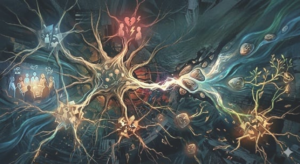
Why this happens (you may know some of this already)
You may have come across the language of fight, flight, freeze and fawn — the four stress responses. If you have, stay with me anyway, because there is often more here than the popular version carries.
These are not personality types. They are not character flaws. They are not, strictly speaking, choices. They are shapes the nervous system takes when it senses pressure it can’t easily move through.
Fight is the one most people recognise. The system mobilises — energy moves outward, attention sharpens around the problem. In daily life this can look like pushing harder, controlling outcomes, micromanaging, defending positions strongly, working with urgency even when rest would serve better. The system is active. It is also narrowed. Range gets sacrificed for traction.
Flight is harder to spot because it often masquerades as productivity. Staying constantly busy. Avoiding the difficult conversation by always having something else to do. Over-preparing. Shifting quickly to the next task before the current one has fully landed. Movement continues. Ease doesn’t.
Freeze is the one most often misread, because it doesn’t look dramatic. It looks like postponing important things. Losing clarity at the moment it matters. Feeling blank or distant in conversations that should engage you. Difficulty beginning. People in freeze states are routinely labelled unmotivated or indecisive — even when something much more specific is happening underneath.
Fawn is the most misunderstood of the four. It gets called “people-pleasing,” which is unfair, because it is rarely a deliberate strategy. It is a reduced ability to take up space — smoothing conflict quickly, agreeing outwardly while uncertain inwardly, holding back opinions, deferring strictly to hierarchy. Sometimes it shows up as compliance. Sometimes as aloofness — the same response wearing a different face.
Here is the part the popular versions often skip: these aren’t only emergencies.
People cannot instantly become assertive when their systems are organised around accommodation, just as they cannot instantly become energetic when their systems have narrowed into conservation.
Nervous systems shape what feels possible in the moment.
Changed baselines
We usually think of stress responses as temporary — something the system enters, then leaves. Often that is true. But nervous systems can also settle. What was once a response becomes, over time, a setting.
In the ecosystems many of us live in today, stress is frequent enough that the temporary becomes ordinary. The mobilised state becomes “just how I work.” The narrowed range becomes “just how I am.” We marinate in patterns long enough that we forget they are patterns. We begin to believe our current range is our natural range.
The doorways haven’t disappeared. They have just become harder to see. (Read more on how this compares to a mansion with different rooms here.)
This is one place where Split Coherence offers something the stress-response model doesn’t, on its own, give us.
Stress responses describe what happens in a moment. Split Coherence describes what happens when those moments stop being moments — when they become organisation.
When parts stop speaking to each other
When pressures persist, the narrowing isn’t only in intensity. It is in coordination.
A person may value honesty but hesitate to speak. Someone may feel exhausted but continue working efficiently. A leader may carry doubt privately while appearing certain publicly. Decisions may move forward without the participation of emotions or values that once mattered.
The capacities haven’t gone anywhere. They have just stopped consulting each other.
This kind of separation is not only psychological. It is also physiological — a form of functional disconnection within the nervous system itself. In clinical settings, stronger forms of this are described as dissociation. In high-functioning environments it looks quieter, but it is the same family of pattern at a different intensity. People continue to perform. Different parts of experience remain separated. And over time, this can begin to feel normal.
And this pattern doesn’t only happen inside one person.
Systems shape nervous systems
What we have been describing inside one nervous system happens at every level above it.
In workplaces, narrowing gets formalised into virtue. A fight response named as ambition. A freeze response named as professionalism. A fawn response named as alignment. The room a culture rewards becomes the only room people learn to enter. The others still exist. They have just stopped being seen as legitimate.
When countries polarise, what we are watching is not only political disagreement. It is collective range collapsing. Entire populations losing the capacity to hold complexity, to sit with another person’s reality, to remain in conversation with what they don’t immediately understand. Two rooms remain open — us and them — and the rest of the mansion goes dark.
Wars are this pattern arriving at its most devastating expression. When fight becomes the only room a system can enter at scale, every other capacity — listening, doubting, mourning, holding more than one truth — becomes structurally inaccessible. Not because those capacities have disappeared in the people involved. Because the system, collectively, has organised itself around survival.
The uncertainty many of us are living inside right now — climate, economy, technology, geopolitics, all in motion at once — produces its own narrowing. When a system cannot tolerate not-knowing, it collapses into certainty. This is its own kind of freeze, just wearing confident language.
Burnout, polarisation, conflict, collective panic — we tend to treat these as separate problems. They may be the same pattern surfacing at different scales. Nervous systems, individual and collective, losing the range to hold what is actually here.
What changed in the conversation
Back to my client. By the end of our session she hadn’t done anything in particular. She hadn’t decided to become spontaneous again or to plan less. Nothing in her external life had moved.
What had shifted was simpler than that, and also bigger.
She had started seeing her current range as a range — not the only one available to her. The “careful version” was still there, still useful, still the right response in many situations. But it was no longer the whole map. The part of her that used to take a trip on impulse hadn’t been deleted. It had become harder to access. Recognising that was, in itself, the beginning of access returning.
This is what coherence actually looks like in motion. Not consistency. Not a single integrated self. The capacity to notice which part is leading, stay aware of what else is present, and respond without abandoning yourself in the process.
You will still narrow. You will still over-identify with one shape. But something shifts in the relationship between the parts. They become less strangers to each other. The rooms become visible again.
Not all at once. Not in isolation. And not at one scale at a time.
Read more about Fragmentation and Coherence in my other articles.